

Every new feature ships with a slightly different table, a new shade of blue and a button nobody has seen before. Your engineers rebuild the same component for the third time this quarter.
This guide covers UI/UX agencies that build design systems for SaaS products. At U1CORE, we build design systems as part of our Design System Development and UI/UX Product Design for SaaS work — so we’ll also show how we approach it.
Why SaaS design systems fail
The system lives in Figma, not in code. Designers keep a tidy library. Engineers never adopt it, and the product drifts away from it within months.
It covers the happy path only. Buttons and colours are documented. Empty, loading, error and permission-limited states are not, so every team invents its own.
Nobody owns it after launch. The agency hands over a file and leaves. New components get added without review until the system is just another inconsistent library.
Typical failure points we see:
- Tokens that don’t map to code. Colours and spacing are defined twice, once in design and once in CSS, and they never match.
- Five versions of the same table. Each module has its own filters, pagination and bulk actions.
- No dense-data components. The system was built for marketing pages, not for dashboards and admin screens.
- Dark mode and theming bolted on. Multi-brand or white-label needs break the system.
- Documentation nobody reads. Usage rules sit in a PDF, not next to the component.
What a design system agency actually fixes
It maps tokens to your codebase. Colours, type, spacing and radius are defined once and read by your front end.
It designs every state. Components ship with empty, loading, error, disabled and restricted states, so teams stop guessing.
It builds for data-heavy screens. Tables, filters, charts and forms are core components, not afterthoughts.
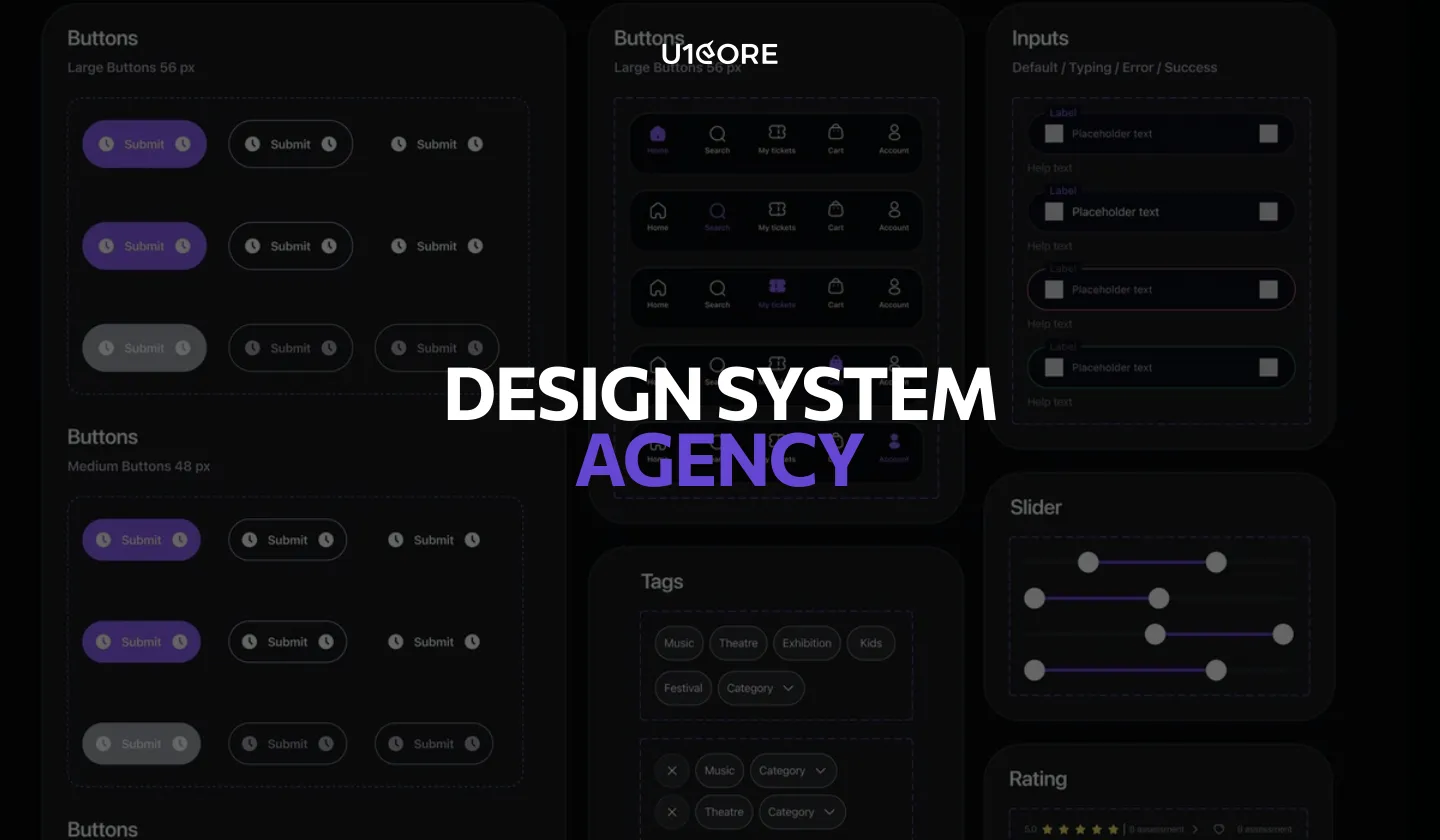
It builds the library, not just the file. Components exist in code, documented in Storybook or similar, ready for engineers to use.
It sets up governance. There is a clear owner, a review process and a way to add new components without breaking old ones.
How to choose a design system agency
Ask who builds the components. Design-only, a spec your engineers build from, or a coded library are three different purchases.
Ask to see states, not palettes. A real system shows error, empty and permission states from a live product.
Look for SaaS and B2B systems. Marketing-site systems rarely survive admin panels and dense tables.
Ask how adoption was measured. The right answer is the share of screens built from the system, not the number of components.
Top 7 agencies for SaaS design systems
1. U1CORE
Best for: SaaS companies that want a design system designed, coded and adopted by one team.
U1CORE is one team for product strategy, UX/UI design and development, with 31 SaaS projects among 350+ delivered and a 5.0 rating across 52 Clutch reviews. For BridgeFleet, five user roles shared one web and mobile platform, so we built the design system alongside the wireframes rather than after them. One card, chart and table language now covers every role, and the platform reached +75% operational efficiency with 0% payroll calculation errors.
What U1CORE does on design system projects:
- UI audit — inventory of every component variant across your product.
- Tokens — colour, type, spacing and radius mapped to your front-end stack.
- Core components — tables, filters, forms, charts and navigation with every state.
- Theming — light and dark modes, white-label and multi-brand support.
- Coded library — components built and documented for your engineers.
- Governance — contribution rules and a review process after launch.
Why teams choose U1CORE: a fixed quote and timeline within 24 hours of a brief, and the team that designs the system builds it.
2. EDL
Best for: teams whose engineers need tokens mapped exactly to an existing codebase.
Copenhagen design system agency; on Cloud Factory it reports 70% system adoption, 1.5× faster delivery and 30% less QA time.

3. Humbleteam
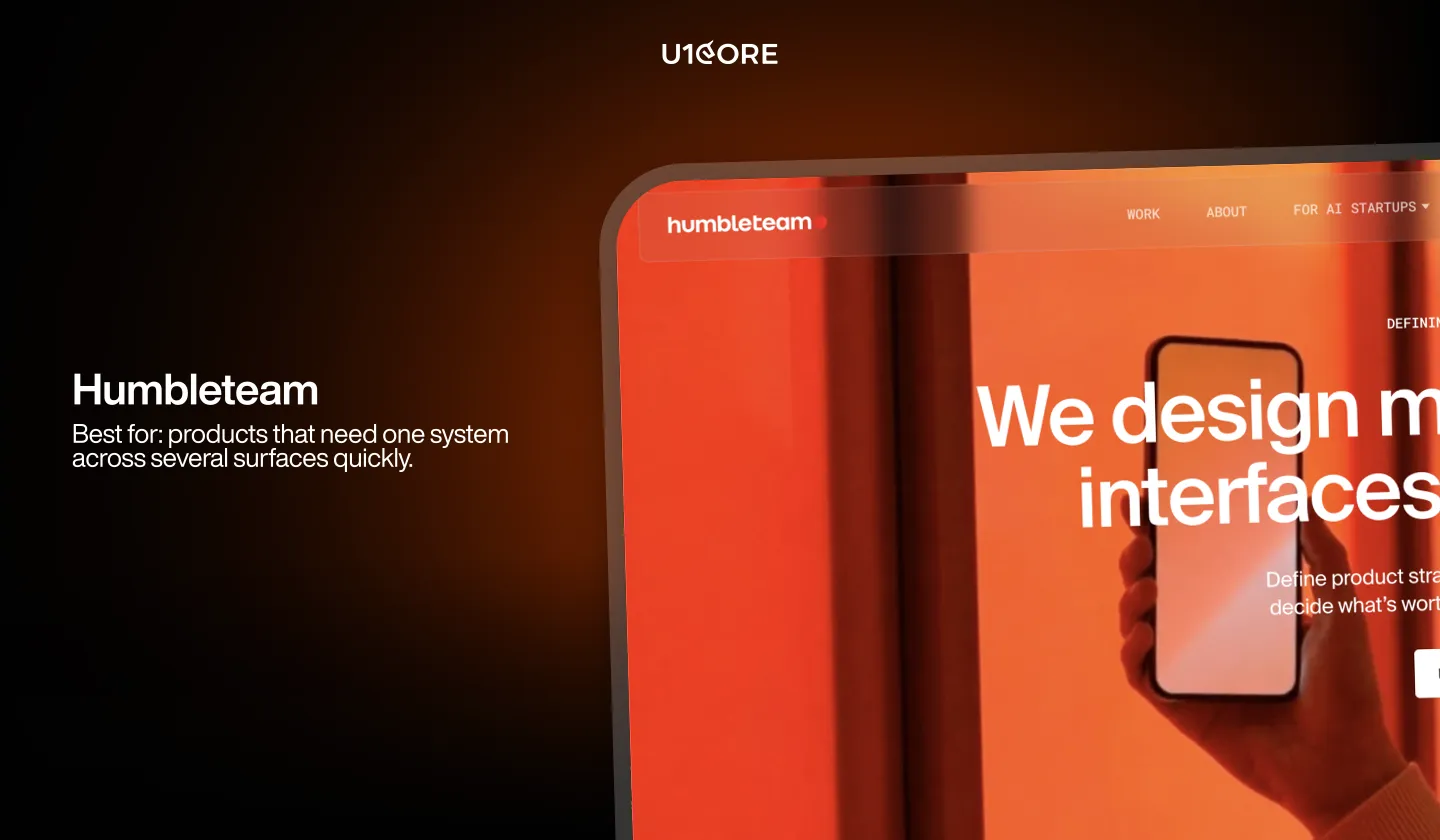
Best for: products that need one system across several surfaces quickly.
London, Prague, Dubai and San Francisco agency that took Logitech’s Dock Flex system across four surfaces to production-ready in four weeks.
4. Phenomenon Studio
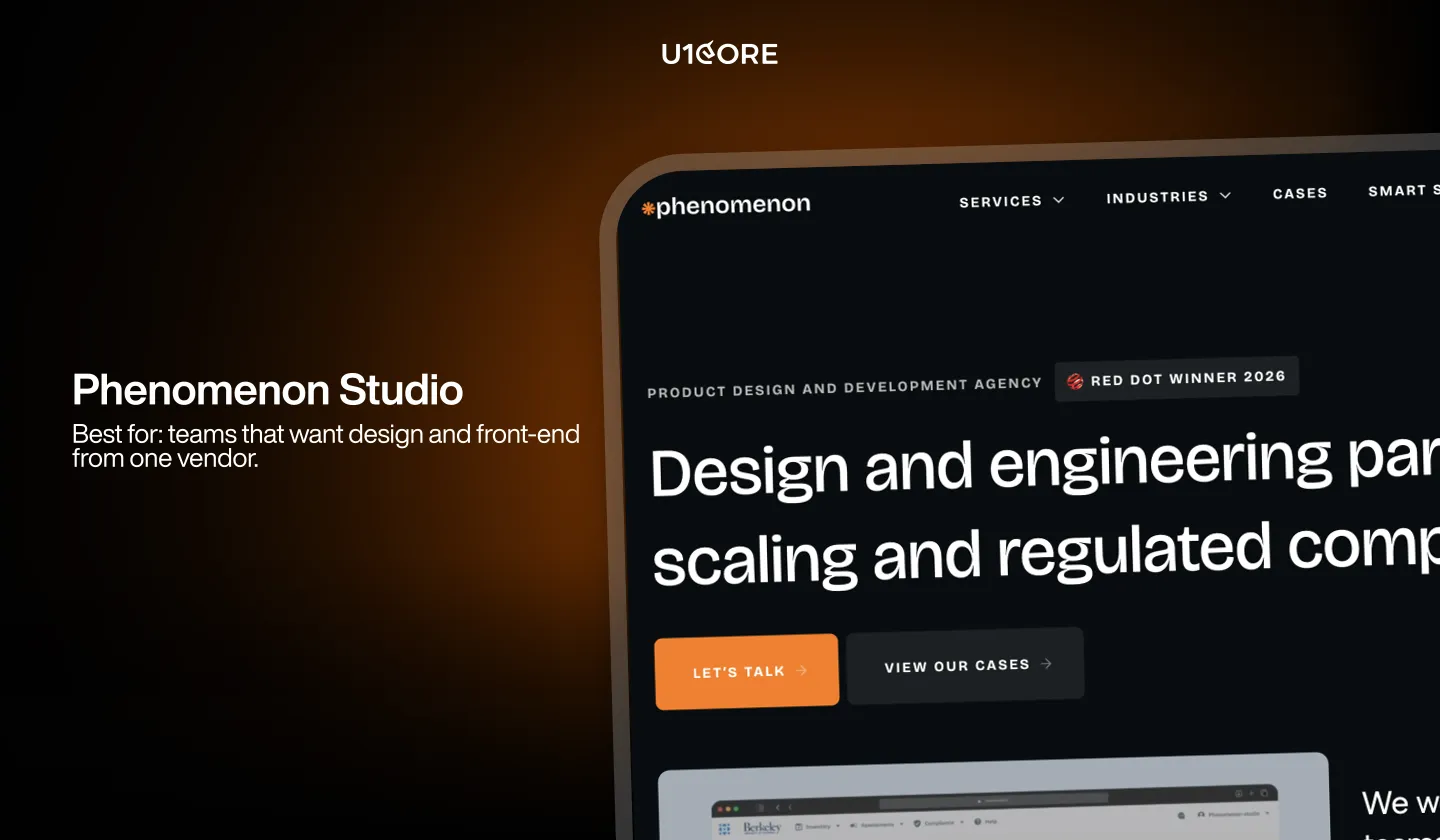
Best for: teams that want design and front-end from one vendor.
Tallinn, Lugano and Dover studio whose Isora case pairs reusable components with a Storybook mirror.
5. Ramotion
Best for: funded SaaS companies aligning brand and product UI.
San Francisco studio with work on micro-interactions for Salesforce’s Lightning Design System ($50,000+ minimum on Clutch).
6. Eleken
Best for: SaaS teams with engineers in place that need design-only system work.
Kyiv SaaS-only design agency offering design systems and embedded designers on subscription.
7. Netguru
Best for: large programmes that need engineering at scale.
Poznań company offering discovery, design systems and development (Clutch 4.8, 73 reviews).

Agency comparison at a glance
U1CORE — design system, coded library and product build in one team. Best fit for multi-role SaaS where adoption matters more than the file.
EDL — token-first systems mapped to code. Best fit for teams with strong in-house engineering.
Humbleteam — fast systems across several surfaces. Best fit for device-linked or multi-app products.
Phenomenon Studio — components plus front end. Best fit for one-vendor delivery.
Ramotion — brand-led product UI. Best fit for funded SaaS with larger budgets.
Eleken — design-only system work. Best fit for teams that build in-house.
Netguru — systems inside large engineering programmes. Best fit for enterprise scale.
How U1CORE approaches design systems
1. UI audit (1–2 weeks). We list every component variant, state and inconsistency across the product.
2. Tokens and foundations (1–2 weeks). We define colour, type, spacing and radius and map them to your front-end stack.
3. Core components (3–6 weeks). We design tables, forms, filters, charts and navigation with every state, tested on real screens.
4. Build and documentation (4–8 weeks). We code the library, document usage next to each component and migrate priority screens.
5. Governance (ongoing). We set contribution rules, review new components and track adoption across the product.
Rebuilding the same component for the third time this quarter? U1CORE is the partner in crime for strong businesses whose digital and operations don’t yet play at their level. We’ll build a design system your engineers actually use. Book a strategy call or explore our Design System Development services.